 Back to News & Insights
Driving Improvements in Clinical Coded Data Across British Columbia
July 17, 2025 • Reading time 2 minutes
In hospitals across British Columbia, clinical coders in Health Information Management (HIM) convert patient information in Electronic Medical Records (EMRs) into coded data, using ICD-10 CA for diagnoses and CCI for procedures. This standardised data enables easier analysis and supports benchmarking provincially and internationally. In Canada, data is reported to the Canadian Institute for Health Information (CIHI) and provincial Ministries of Health, with inpatient data sent through the Discharge Abstract Dataset (DAD) and emergency data through the National Ambulatory Care Reporting System (NACRS). Continuous quality assessments and education are essential to maintain high-quality coded data.
Edge Health worked with our partners to identify and drive improvements in clinical coded data across British Columbia.
What we did
Over 15 months, we supported Beamtree’s analytics workstream across 14 hospitals in British Columbia, enhancing clinical coding quality. Using Beamtree’s PICQ and RISQ software, we analysed patient records, identifying coding discrepancies and hospital harm indicators to assess the impact on key metrics like Resource Intensity Weights (RIWs).
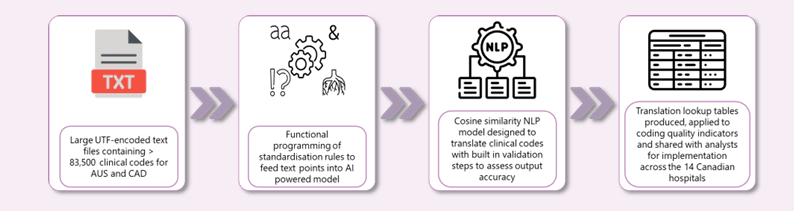
To streamline this, we developed an AI-powered NLP solution that automated clinical code translation between Australian and Canadian systems, achieving over 98% accuracy. This solution enabled the use of 617 pre-existing metrics in Canada without redesign, accelerating delivery by six months.
What we achieved
Our findings, detailed in a report, provided actionable recommendations, including improving collaboration between coding and decision support teams, optimising record allocation based on coders’ expertise, and prioritising high-importance records. Additionally, we informed education sessions, guiding coders to reduce errors and standardise practices for greater data accuracy.
The recommendations from this work have been used to develop a workplan and business cases for the Lower Mainland and Interior Health clinical coding teams, informing clinical coding practices and workforce strategy in the years to come.

Jennifer Connolly
Jennifer is Edge Health's Canadian lead, an experienced health economist and modeller specialising in the application of economic and statistical modelling techniques to improve decision-making and drive operational improvements.