 Back to News & Insights
Future-Proofing Healthcare Funding in Surrey Heartlands: Shaping investment for better outcomes, greater value, and sustainable care
August 26, 2025 • Reading time 3 minutes
Surrey Heartlands Integrated Care Board (ICB) set out a clear ambition: to make sure every pound spent delivers the best possible outcomes for local people while keeping the system financially sustainable. Guided by the Darzi Review and the NHS Long Term Plan, the ICB wanted to rebalance spending across its services, shifting more investment into prevention and community-based care, while maintaining standards in hospitals.
Edge Health was commissioned to support this challenge by developing a future healthcare funding model that would work within available resources, drive productivity and quality, and support the long-term health of the population.
A disproportionate amount of ICB budgets is spent on acute services
More than half of Surrey Heartlands’ funding currently goes into acute hospital services, a proportion that has been rising in recent years. This results in less investment in primary, community, and mental health services when compared to other ICBs in the surrounding regions. At the same time, analysis suggested there were opportunities to make hospital care more efficient. For example, only one of the four local trusts was achieving the national target of 85% theatre utilisation. Average lengths of stay were also longer than in the highest-performing ICBs: 29% longer for elective admissions and 11% longer for non-elective admissions.
Building a future funding model for Surrey Heartlands
Working closely with the Surrey Heartlands, Edge Health analysed detailed Patient Level Information and Costing System (PLICS) data, focusing on inpatient care, which accounts for around 60% of acute spending. These data were used to develop three cost models: for non-elective, elective, and high-volume low-complexity elective care which captured the different cost dynamics in each area. By separating the factors that reflect population need from those that can be influenced by the way care is delivered, it was possible to model the potential impact of operational improvements alongside the effects of population growth.
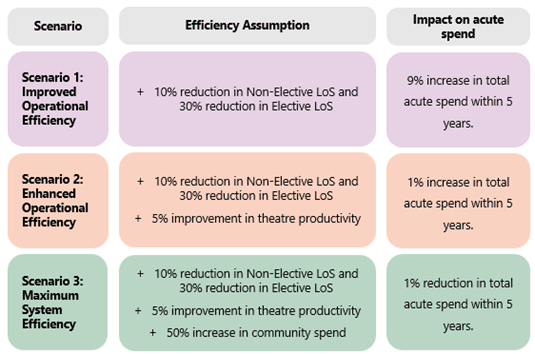
Using this approach, we explored three scenarios. The first involved improving operational efficiency through shorter lengths of stay: 10% for non-elective patients and 30% for elective patients. The second combined these improvements with a 5% uplift in theatre productivity. The third went further, adding a 50% increase in community spend to the other efficiency measures.
Improved efficiency and allocation of activity could absorb cost growth or go further
Without change, acute costs were projected to rise by 12% by 2029/30, driven mainly by growth in non-elective activity. The modelling showed that realistic efficiency gains could offset this increase entirely, and in some cases deliver net savings. Reinvesting these savings into community services, or shifting some high-volume low-complexity elective procedures out of hospital, would help Surrey Heartlands to align more closely with national policy, support prevention-first approaches, reduce pressure on acute services, and deliver better value for local people.
“Edge Health brought deep analytical expertise and a collaborative approach to help us model the future of healthcare funding in Surrey Heartlands. Their work has given us a robust evidence base to rebalance investment, improve efficiency, and support a sustainable, high-quality, health system for our population.”
Jack Wagstaff
Executive Director of Strategic Commissioning, Surrey Heartlands ICB
This work has given the ICB an evidence base for balancing investment between hospitals and community care. It provides a shared framework for discussions with local acute providers on how to meet rising demand without compromising quality, ensuring that Surrey Heartlands’ health system is both sustainable and focused on improving outcomes for its population.

George Batchelor
George is a Co-Founder and CEO of Edge Health and has a background in economics and data science. A core part of George’s approach is providing a clear narrative for complex analysis so that its insights are actionable for people with a range of backgrounds (clinical, operational, administrative).

Lucy Pirkle
Lucy is a Senior Consultant at Edge Health. She leads a portfolio of evaluations for a range of novel innovations across health and care settings to ensure optimal resource allocation within the NHS.