 Back to News & Insights
The Blueprint for Recovery: Unpacking the National Cancer Plan for England
February 13, 2026 • Reading time 3 minutes
Earlier this month, the Department of Health and Social Care released their latest strategy for the provision of healthcare within England: the National Cancer Plan for England. Designed in response to the Darzi Review, which concluded that the NHS is in a ‘critical condition’, this document represents a move away from incrementalism and towards reform.
As our Cancer Waits Dashboard shows, in September 2025, 74% of patients receive a diagnosis within 28 days, 66% of patients start treatment within 62 days and 91% of patients start treatment within 31 days of a decision to treat. The plan moves beyond high-level aspirations by setting rigorous, measurable performance goals to be met by March 2029, such as:
- 80% of patients to receive a diagnosis or “all-clear” within 28 days of referral.
- 85% of patients starting treatment within 62 days of referral.
- 96% of patients starting treatment within 31 days of a decision to treat.
To achieve these goals, the plan outlined actions that the NHS can take, such as boosting investment in community diagnostic clinics, modernising outpatient clinics and using technology to increase diagnostic capacity.
This document is supported by 17 case studies that move these ideas from theory to proven practice. These include the ‘Diagnostics Single Queue’ in Greater Manchester, which saved 17,000 patient pathway days through real-time booking, and ‘YouScreen’ in London, which successfully used self-sampling kits to boost cervical screening in underserved communities.
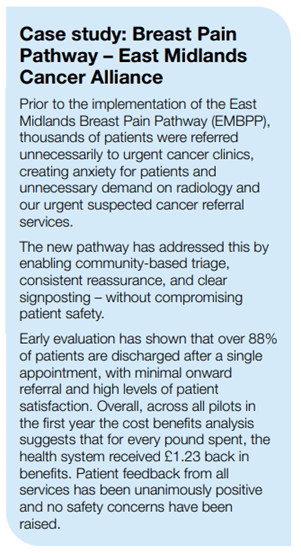
We are pleased to see that the first of these 17 case studies was the ‘East Midlands Breast Pain Pathway’ (EMBPP). Edge Health partnered with the Health Innovation East Midlands to evaluate this pathway at both an East Midlands and National scale, producing two academic papers to date, where we explored features of the successful pathways including integrated primary and secondary care, and an experienced clinician. This pathway is a genuine example of where there are tangible and genuine wins within reach being delivered across the NHS, with our evaluation showing better patient outcomes, satisfaction and a positive cost-benefit ratio. You can read our East Midlands Evaluation published paper here and our National Evaluation published paper here.
What is perhaps most striking about this plan is its motivational tone. It acknowledges that the UK has historically lagged behind international peers and argues that “reform or die” is the only choice for the status quo. While the plan highlights pockets of excellence like the EMBPP, the perennial challenge for the NHS has been scaling projects like this from pilots to the national system due to fragmented funding and varying regional priorities. The National Cancer Plan directly tackles this by:
- Incentivising adoption through the ‘earned autonomy’ model. Systems that adopt proven, cost-effective innovations are given greater funding to reinvest their savings.
- By providing 17 ‘blueprints’ as a foundation of this policy, the government is moving away from suggestions to actionable rollouts.
By embedding real-world case studies directly into national policy, the Government has demonstrated that the radical changes suggested are not only necessary for the future of healthcare but are also achievable today. The focus now shifts from proving what works to the disciplined, nationwide execution required to meet the 2029 targets.

Izaak Gilchrist
Izaak is a Senior Analyst at Edge Health with a background in Data Science. He has led on a variety of data analytics and health evaluations across a diverse range of topics including virtual interventions, primary and community care, and paediatrics.