 Back to News & Insights
Developing a flexible, secure platform to support better decision-making within Adult Social Care
July 24, 2025 • Reading time 4 minutes
What we did
The adult social care (ASC) sector in the UK lags similar industries when it comes to the adoption of data, digital tools, and technology. To address this, The Department of Health and Social Care (DHSC) has recently engaged in a wider program of work to transform how the sector leverages its data for operational and strategic decision making. As part of this, we have been selected by the department, along with our partners Made Tech, to create a data platform, Get Adult Social Care Data (GASCD), that hosts and displays ASC data for the sector to use. To create a flexible, secure platform, we set up greenfield architecture that could support the continuous delivery of value to the Adult Social Care sector.
How we did it
Architecting a solution for the unknown
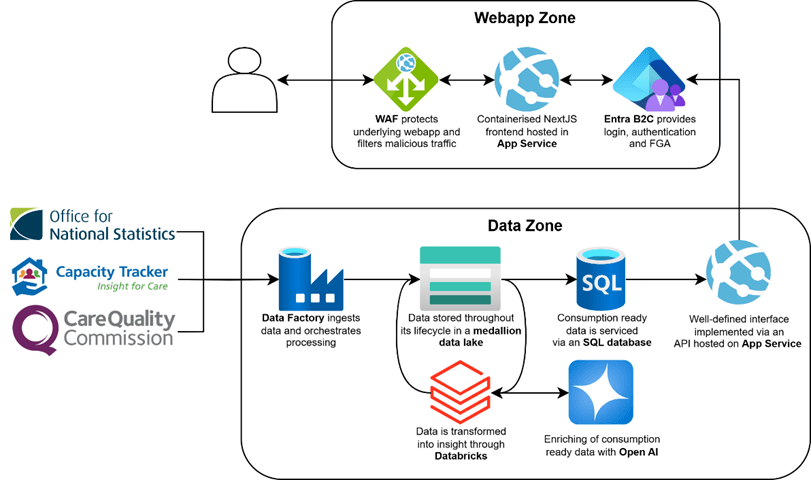
To integrate data from disparate sources and deliver actionable insights to end users, we identified two primary needs:
- A scalable and extensible data architecture to ingest, curate, and enrich ASC data, preparing it for effective use across the sector.
- An internet-facing application that could consume and present these insights to users in a user-friendly, accessible manner.
Recognizing the evolving nature of user needs, both known and yet to emerge, we architected the platform with long-term flexibility in mind. Instead of retrofitting a solution into existing infrastructure, we built a dedicated platform that could evolve with the sector’s needs. This included a landing zone architecture with distinct ‘data’ and ‘application’ zones, separated by a well-defined interface. This approach empowers teams to independently develop their respective zones while maintaining clear, manageable integration points. It also enables the development of additional zones for future enhancements, such as APIs for programmatic access to the insights, further supporting the DHSC’s long-term data transformation goals.
Automating the delivery of value to the sector
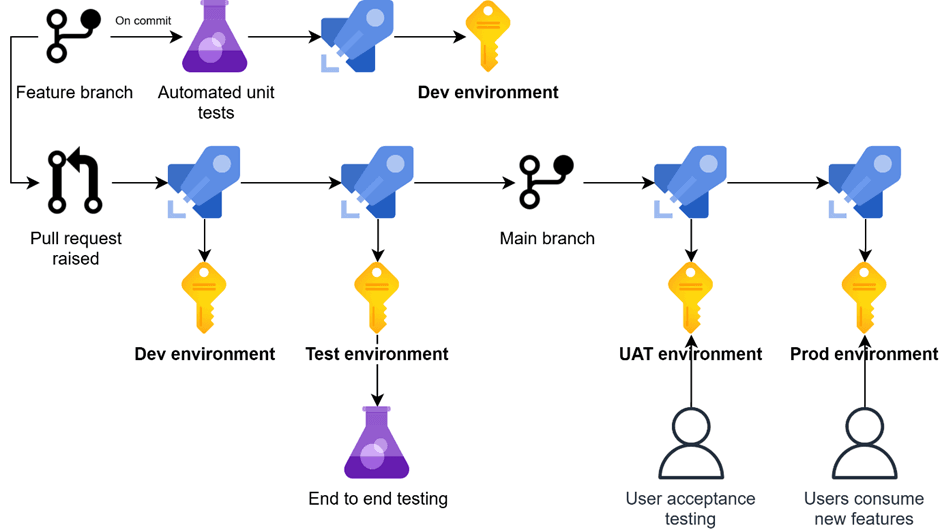
To deliver completed features to users in the Adult Social Care sector quickly and safely, we implemented fully automated deployment pipelines that reduce the risk of human error and protect production system stability. Our approach included:
- Test automation: Enabling continuous integration through embedded automated testing on commit using tools like Cypress. Tests give developers immediate feedback on code quality and system impact, enabling rapid integration of features into deployable artifacts.
- Automated deployments: Using Azure DevOps, we built end-to-end pipelines that handle build and deployment processes automatically. This included Infrastructure as Code with Terraform, DACPAC for database changes, and tooling for packaging and releasing application artifacts—enabling true continuous delivery and aligning with the DHSC’s broader cloud strategy.
- Multi-environment strategy: We maintained separate environments for development, testing, and production. This ensured robust validation of features before release and protected the production environment from unstable changes.
By automating the delivery process, we empower teams to focus on developing valuable features rather than manual release tasks. This also fosters greater ownership of quality and delivery across the team, eliminating the need for a formal change advisory board (CAB) while ensuring the reliability and security of the production system—critical for the sector’s ongoing transformation.
Early engagement to build secure, strategically aligned solutions
Given the sensitivity of Adult Social Care data and the scale of the platform, we prioritised early decisions around technology stack and security. From the outset, we actively engaged with key departmental stakeholders, including:
- Information security teams to understand relevant policies, risk areas, and compliance requirements
- Cloud architecture teams to align with existing capabilities and inform design decisions
By involving these stakeholders early, we ensured that critical security and architectural considerations were addressed upfront—avoiding costly rework later. For example, we pivoted an early proof of concept from AWS to Azure to better align with DHSC’s strategy and existing operational capabilities.
Security was embedded in the delivery process from day one. Our team included members with a strong understanding of information governance and security requirements, allowing us to integrate these into both the overall platform and individual features. We adopted a DevSecOps approach, promoting shared responsibility for security across the team and throughout the development lifecycle.
The outcome
The result was a set of robust technical foundations, aligned with industry best practices, that not only enabled successful delivery of the private beta but positioned the project for long-term success.
- Minimise lead time for getting new features production-ready
- Enable on-demand releases without relying on lengthy, manual release cycles
- Preserve system stability and quality, ensuring a reliable and consistent user experience
“Edge Health’s expertise in data was evident in day-to-day engagement and the quality of their deliverables. Edge Health were able to quickly grasp the core of an issue and translate our requirements into actionable steps for the team.”
Raj Malhi
Head of Strategy and Data, Department of Health and Social Care
Together, these foundations support the continuous delivery of value to the Adult Social Care sector, allowing for iterative improvement and faster alignment with user needs.

George Caws
George is the Engineering lead at Edge. He specialises in the design, development, and implementation of scalable data & digital solutions for better data-driven decision making in health and care organisations.

Maria Starovoitova
Maria is a Senior Consultant at Edge Health with a background in statistics and computer science.
She has a diverse set of experiences supporting NHS organisations with statistical analysis, demand and forecasting modelling, data visualisation and application development.