 Back to News & Insights
The Future of Dashboards: How AI Translates Data into Strategic Insights
November 11, 2025 • Reading time 2 minutes
NHS data directly supports care delivery and drives service improvements across the health system. Every week, leaders and managers spend hours analysing their dashboards to monitor the performance of their services, such as their capacity and efficiency. The data is there, but managers often must handle tricky follow-up questions; what are the implications of the data? And what can NHS service providers do next?
The Gap Between Visualisation and Insight
A chart might show that the average treatment wait times in your speciality are at 20 weeks. But what does it really mean? Is it improving or declining? How does it compare regionally? And most importantly, what specific actions should be taken?
Traditional dashboards excel at showing what’s happening, but fall short on what it means and what to do about it. These often leads to dashboard users misinterpreting the data and making sub-optimal operational decisions.
Generative AI-driven Analytics: From Numbers to Action
This is where large language models (LLMs) can transform analytics. Rather than leaving interpretation to users, AI models can act as an embedded analyst reading your data, understanding your context, and making tailored recommendations in seconds. As a result, AI-enabled dashboards empower leaders to rapidly understand their data and make the right decisions to improve their services.
To demonstrate how this technology can augment dashboards, we have created a new AI capability for our publicly available NHS Data Analytics and Software Hub (DASH). The underlying model automatically analyses the referral-to-treatment trends, uses contextual information, such as the NHS ten-year plan priorities and flags where targeted intervention is needed most.
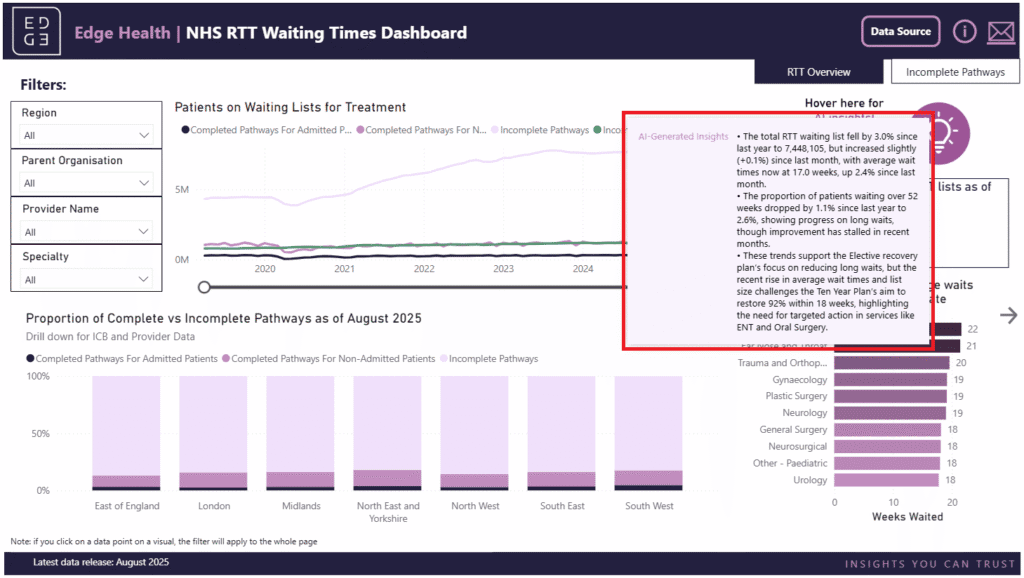
See It in Action
These AI-powered dashboards are already driving changes in decision making, allowing optimal, data driven decision making. For example, our AI-enabled insights platform for the UK Foreign, Commonwealth and Development Office (FCDO) has reduced time spent on manual data collection. This change has not only freed up time for their analysts to focus on analysis instead of data-wrangling, but also enables more data to be collected, allowing for faster, evidence-based decision-making and more targeted policy interventions.
Explore our updated NHS DASH and see how AI turns referral-to-treatment data into actionable, strategic insights.
Contact us to discuss how we can bring similar AI-powered capabilities to your organisation’s dashboards.

Christian Moroy
Christian is a director and co-founder of Edge health. He leads teams of consultants and analytical experts in the delivery of client engagements delivering advice, products and support that enable evidence-based decisions, strategic support and operational improvement.

Tom Michaelis
Tom is a Lead Data Scientist at Edge Health with experience creating AI-powered products for the life science sector. He has led on the development and deployment of Machine Learning and Generative AI algorithms to solve pain points within private and public sector.

Yammi Yip
Yammi is a Senior Analyst at Edge Health with a background in neuroscience and psychology. Her expertise spans data analysis, modelling and evaluations, such as developing a microsimulation model to assess the impacts of extreme heat on health and care service delivery, as well as evaluating the use of AI technology in skin cancer pathways.

Temitope Sanni
Temitope is a Data Engineer at Edge Health, with a background in Data Science. He specializes in designing, building, and optimizing scalable data pipelines that enable more effective decision-making across healthcare and related sectors.