 Back to News & Insights
NHS Online: Understanding workforce motivations and preferences
March 25, 2026 • Reading time 2 minutes
The NHS is setting up an “online hospital” – NHS Online – in a significant reform to the way healthcare is being delivered. This is a new innovative care model which will not have a physical site but instead will connect patients digitally to expert clinicians anywhere in England. That means patients can be seen faster, as teams triage them quickly through the NHS App and let them book in diagnostics and treatments closer to their home.
In late 2025, NHS England commissioned Edge Health to conduct research on clinicians’ willingness to offer time to NHS Online. Our study, conducted between December 2025 and January 2026, combined a national survey with seven clinical focus groups.
The resulting data provided a foundation for building workforce models that don’t just project capacity but align with clinician preferences and professional needs. Overall, there is a significant interest in NHS Online, with 60% of consultants and SAS doctors willing to contribute time, a level of engagement that exceeds current projected demand. The primary motivations for participation are the ability to work flexibility across location and time and the opportunity to increase earning potentials.
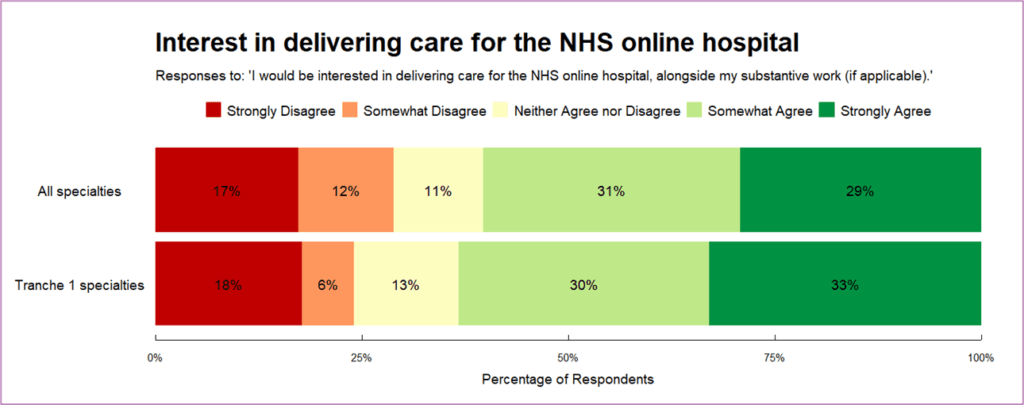
For NHS Online to be successful, consultants and SAS doctors care greatly that the model works and value that clinical safety and quality of care is underpinned by seamless technology and operational processes. Although interest is high, concerns around medico-legal responsibility and the potential impact on tax or pension thresholds are key questions for consultants and SAS doctors to contribute time to NHS Online.
In line with the desire for flexible working, most respondents of the survey envision contributing between one and eight hours per week, with part-time workers forming the largest interested cohort. During this time, consultants will perform both patient-facing and non-patient facing activities, of which there is an even split in interest. This suggests that NHS Online is unlikely to face capacity challenges for either type of work.
Similar to offering time to a staff bank, consultants and SAS doctors prefer casual contracts when working for NHS Online, which again highlights the desire for flexibility. Most consultants are used to reward systems based on hours worked, compared to activity based, which was also the slightly preferred option in our engagement. However, when taking into account those with no preference, the difference is negligible.
The research suggests that the consultant and SAS doctor capacity is well-positioned to meet projected demand. Positioning flexible working at the heart of the model will be essential for successful recruitment and retention, while current concerns should be addressed.
By grounding these findings in operational reality, Edge Health is helping to design a service that is both resilient for the NHS and attractive to clinicians.
Read our report

Jonathan Bruce
Jon is a Director at Edge Health, an experienced health economist and modelling expert. Jon specialises in the application of economic and statistical modelling techniques to improve decision-making and drive operational improvements.

Virginia Dall’O
Virginia is a Senior Consultant at Edge Health. She has led multiple engagements supporting Trusts on the ground, managed large national data programmes and managed teams to develop sophisticated analysis to support quality improvement.

Laura Dell’Antonio
Laura is a Consultant at Edge Health with a background in biochemistry and infectious diseases. At Edge Health, her work spans building data platforms for health and social care, health economic evaluations across infectious and chronic disease and pharmaceuticals, as well as leading clinical and user engagement to design services and improve tools. She works closely with stakeholders to deliver analysis that is accessible and drives meaningful improvement across health and care services.