 Back to News & Insights
Three ways to ensure insights from your data products drive improvement on the front line
September 17, 2025 • Reading time 4 minutes
Data products are a key tool to enable healthcare teams to drive change at the front line.
We have successfully deployed dozens of data products into the NHS and wider health and care sector over the last decade, including HSJ winning SPaedIT to drive elective recovery for children and young people, or our SpaceFinder surgical scheduling tool to improve theatre utilisation.
In this post, we will walk you through three key ways to ensure insights from your data tools are successful with users and enable them to act.
Earn trust from your users by validating your data and metrics with them
High quality user research and user centred designs are key to data product development and ensure product features and functionality align with users’ expectations.
However, beyond features and functionality, the key aspect of data product development is ensuring the data itself is aligned with their expectations.
This means bringing them along the journey of metric development, treating the numbers that come out of your co-designed business logic as a proof of concept, iterating this alongside the users until they recognise the numbers they see, even if they don’t like them.
State of the art features and functionality won’t win users if they don’t trust the data.
Our way of approaching this is through a three-step process:
- Engage users 1:1 to understand what they currently measure, what they wish they could measure, why they do that and what they need to achieve.
- Prototype measurements based on their approach, and test and iterate the logic and figures with them until they are right.
- Build production ready versions of the logic with auditable metadata.
In partnership with the GIRFT programme, we applied this methodology to 30 medical specialties to produce several hundred co-designed and iterated metrics. The outputs of this process are used by national programmes, ICBs, and providers to benchmark and inform performance. Read more about this here.
Gain buy-in from your users and give an explanation that resonates through story telling
Headline figures like overall opportunity are useful to understand how you are performing and the benefits of improvement, but often provide limited guidance on how to achieve that. This often makes it feel optimistic, unrealistic or out of reach.
Piecing together the key building blocks behind headline figures brings your users along on the journey and tells the story of where they come from, enabling them to identify actions they can take.
How we tackled this challenge on SPaedIt, a HSJ award winning tool
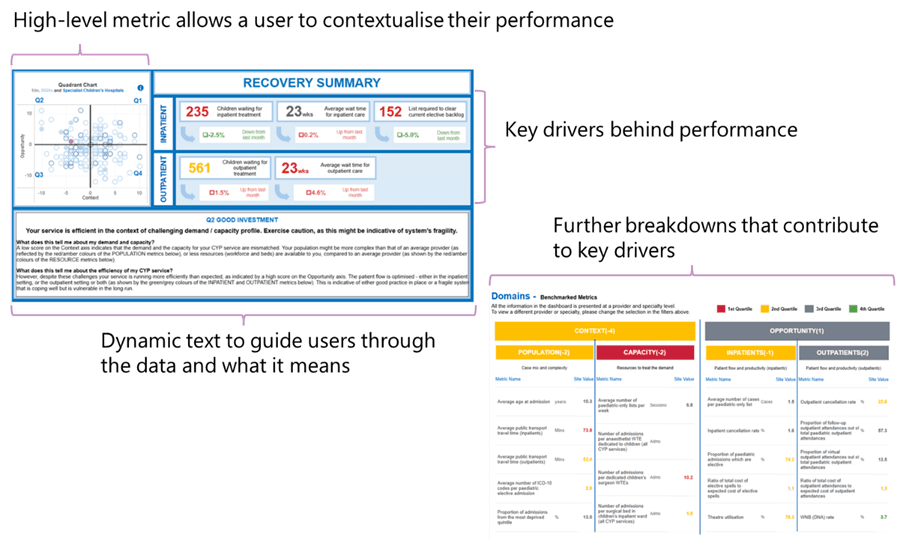
Read more about this here.
For users who do not feel comfortable with charts and data, recent advancements in generative AI provide the opportunity for text-based outputs that can drive impact more directly by explaining what the data show and how to act on the back of it.
Impactful data products never sleep, keeping users engaged through quick and continuous delivery
To keep users engaged with your product, you need to be continuously delivering features and improvements that solve a real need. This means taking new ideas from design to the users’ hands as quickly as possible, so you can collect feedback and iterate achieving the desired impact.
You should strive for these cycles of delivery and feedback to take days, not months, or you risk losing engagement and momentum.
This can be achieved by:
- Breaking releases into smaller pieces: instead of delivering a long list of features, deliver one, collect feedback, and iterate while you deliver the next.
- Automate as much of the development process as possible to enable smaller releases without increased overhead, and ensure focus remains on building innovative solutions that matter, not handle cranking.
- Utilise cross-functional teams that are oriented with the problem area they are trying to solve, not the technical capabilities they provide. This ensures focus on the end goal, not the process.
Being able to respond to changes and user feedback in a timely manner is critical to keeping users’ interest and making an impact.
Read about how we enabled the continuous delivery of value to the Adult Social Care sector here.
Summary
Data products should drive change and improvement at the front line. This will only happen if you build data products and insights tailored to your users, in a way that they can understand and action, while being set up to stay relevant in an ever-changing sector.
At Edge Health, we understand this, and we understand that your users and challenges are different. This is why we work with you, your architecture, teams, and users to deliver impactful outcome-focussed solutions. Read about our work on Engineering Data Solutions and AI and get in touch with us.

George Caws
George is the Engineering lead at Edge. He specialises in the design, development, and implementation of scalable data & digital solutions for better data-driven decision making in health and care organisations.